
Nha Trang, Vietnam

Monday | November 24, 2014
What a fascinating day! Although the day started slowly and clumsily, it blossomed into what could be a life–changing event.
Around 8:00AM, we arrived in Nha Trang, Vietnam, one of the country’s leading vacation destinations. While the locals might boast about the massive white statue of Buddha, the first thing I noticed when we pulled close is the massive cable car that appears to go from one mountain to another – right over the sea.
In fact, with the total length of 10,892 feet, and traveling at an average height of 60 feet, the Vin Pearl is the world’s longest sea-crossing cable car system. I would like to experience this, but I hope my claustrophobia doesn’t get the better of me. And regardless, I assure you that I will have an empty bladder when I first get on that cable car.
Meanwhile, when we tied up and were boarded by the local Vietnamese customs officials, it seems they flipped out that the maps on the ship referred to this body of water as the South China Sea. That is exactly what the water is called on virtually any map in the world, but because the Vietnamese detest the Chinese so much, they insisted that we cross the word China off all the maps, and confiscated any maps within reach. This is strange stuff; scary, but true.
I was still waiting for a response from the resident in the UK to whom I had made an offer on his apartment, when the Residential Advisor came up with “a great new idea.” She then told me about a couple visiting the ship who are interested in sharing a larger apartment with someone else. This would be an extraordinarily large apartment, but since the cost (of at least $5.5M) would be shared equally between us, it would not be so untenable. I looked at the apartment and it is indeed glorious. Then, we huddled in Roz’s office to work through the numbers. I asked if she had any other comparable units for sale and apparently there was one. She told me I might not like it as much but offered to show it to me. It is gorgeous! Clearly, it needs a bit of work – but probably not much more than a new carpet (it still has hard wood floors) and a coat of paint. Moreover, even though the existing furniture is viable, we could easily offload it in New York and replace it with the furniture from my old New York abode. Then, I just blurted out a proposal that I just buy the thing out right – without any partners. The numbers are daunting, but with the amazing appreciation we will realize on the apartment we are now in, I can make it work. (Ship money is stupid money and I may stand to make nearly millions on my existing small apartment – in little over three weeks!) Anyway, it’s all very heady stuff so we regrouped and headed up to Tides for lunch where we discussed everything.
At 1:30, shortly before heading out for our afternoon tour, I stopped in Roz’s office and made a formal offer on the new apartment. (Certain it would be rejected, we just wanted to begin the dialogue.) And then I headed out for our tour – a river cruise on the Cai River.
Our tour guy today was essentially useless – the worst we have had so far.
Besides his English being largely incomprehensible, he repeated the same story or insight four or five times. It might not sound bad now, but it was truly annoying, particularly when each little vignette was going to last four or five minutes.
When we left the ship, we saw a truck unloading massive amounts of rice into smaller trucks. Neat local flavor.

As we drove along the beach in Nha Trang, purportedly the 29th most beautiful beach in the world (who would even advertise that?) he told us that the region of South Vietnam had grown from 20 hotels 10 years ago to over 70 hotels today. Indeed, we saw a Sheridan, Intercontinental, and Novotel all together on one block.
On that same street, apparently 1,000 Vietnamese people gather each morning to perform tai chi on the beach plaza.
We arrived at what may have been the town square, deboarded our bus and walked through a series of narrow streets (that stank horribly) to the waterfront. One interesting edifice we passed was a 10th century temple, Ponagar Pagoda, in the middle of town. Built in brick during the second century A.D., Cham, ethnic Chinese and Vietnamese Buddhist flock to this site to make traditional offerings. Although we did not go into it, it was an impressive building from the outside.

Finally, we got to the waterfront and our vessel – well, some might call it a vessel. We were given conical hats for no apparent reason (the boat was covered), but they did serve to seal the heat onto our heads!

We took a tour on the water of the Cai River for about 45 minutes. Fishermen checked their nets, and raised their traps as we cruised past and took in views of coconut farms and rice paddies along the shore. We learned all the boats are blue and red in color. The blue signifies the sky and is meant to transmit the energy from the sky into the water so that the ship will be successful. The red identifies with the money the fishermen will earn when they empty their traps and nets.

On boats such as this, which one would be hard-pressed to define as seafaring, 10 to 15 men set out to the edge of Vietnamese international waters for 20 days.

While half of them fish, the other half make or repair nets. Given the oppressively high humidity and stifling heat we experienced in that short time we were on the water, I cannot begin to imagine living in such desperate conditions for three weeks with people who stink. Oh, and if that is not a bad enough, imagine the odor emanating from the dead and rotting fish who cohabitate with you for those three weeks!
Interestingly, we heard about, and saw, small round bamboo tubs that are used to paddle from the boats to the shore. In United States, we use neat little dinghies, but here, things are just a few centuries more primitive.

The way these fishermen live is just unbelievable. It epitomizes squalor and poverty, in its truest sense. Words cannot depict it as well as photographs. (I only wish I could capture the smell for you.)

Finally, we disembarked and got on with the rest of the tour. The first gentlemen we encountered was riding a massively overstocked motorbike across the small, shaky wooden footbridge we were traversing.(With almost a dozen people on this delicate bridge, I could just imagine Vietcong fighter planes flying overhead and strafing the bridge, careening all aboard into the polluted water below.)
Oh yes, pollution. Let’s talk about pollution. Clearly, the EPA has never toured Vietnam. The water here is so filthy it makes the Androscoggin River in Maine seem like a crystal-clear Minnesota lake. And it stinks, really stinks.
When we finally got back to our bus, we drove through streets that illustrated and personified the horrific living conditions of the people in Nha Trang. One highlight was a local “Good Humor” man.

But one lowlight was seeing a shirtless man stretched out on a card table under a thatched roof, with a “dentist” standing over him, holding pliers and pulling teeth from his mouth. (No photo – I was too horrified and shocked!)
Next stop was a Vietnamese bamboo market. When I first heard the term, I thought it was nothing more than a shopping a souvenir opportunity. But we were pleasantly surprised. It was an authentic little village where we enjoyed some fresh food and drink from coconuts.
We were relieved (literally) to find fairly hospitable bathrooms among the bamboo and straw shacks.

We were treated to a walk through their organic vegetable garden, and saw several foods that were unknown to us, but were represented as being tasty.

A nice little cow also stopped by to say hello.

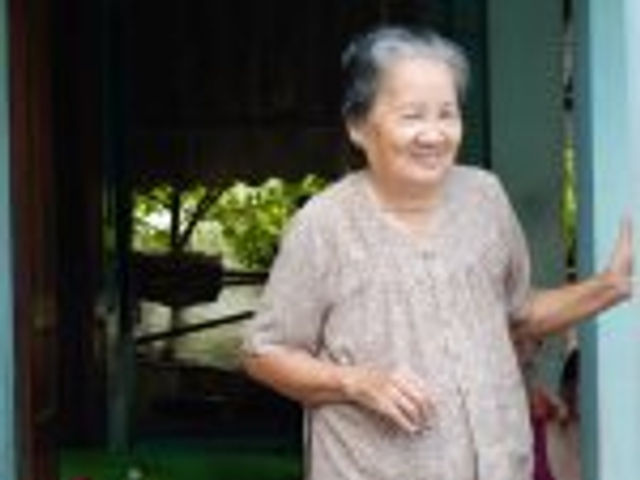
We then visited a small Vietnamese house, and met a charming old woman caring for her grandchildren.
Speaking of caring for children, our next stop was a pagoda where nuns and monks care for orphans and the homeless. The orphanage cares for hundreds of children each day, with 38 actually living there. It was kind of a sad situation and as such, I refused to take any photographs of the children. But I did take a few to memorialize the conditions in which these children live. Here is the main room in which they study and meditate.

And this depicts the way they eat and care for dishes.

And their sleeping quarters.

One little boy was very kind and, when we visited the orphanage’s chapel, he gave us incense as a tribute to the gods.
A few additional words about Vietnamese culture. Ten years ago, there was no running water or electricity in the residential sections of Nha Trang, Now, almost all residences have both. Additionally, it is a very chauvinistic society. Our guide made it clear that women are responsible for cooking, cleaning the home, and raising the children. There is one day a year, October 2, “Women’s Day,” when women are given time off from cooking and cleaning. Other than that, the responsibility is all theirs.
Finally, I wish I could express the feeling of the sweltering heat and humidity that permeates the environment. It is like a jungle. And I could not help but think of how it would be to actually live in the jungle here, carrying 60 pounds of military equipment and weaponry on one’s back, being eaten by mosquitoes and ants, all while being shot at from the land and sky. My heart goes out to all the soldiers who were stationed here during that horrific decade of American history.
Our tour ended with a walk down a local market Street. By this time, however, it was dark, and the trip to the market more dangerous than fun. Nevertheless, we bought three huge papayas.
Back at the hotel, I showered quickly and ran downstairs to meet friends and head out to dinner at The Sailing Club in “downtown” Nha Trang. Dinner was terrific. I had a huge portion of duck and a lamb shank hot pot. We spent hours discussing the ship, apartments and our potential acquisition! Good fun, good friends.


Comments