
Sandakan, Malaysia
- Peter Antonucci

- Jul 8, 2025
- 4 min read
Sunday | November 20, 2016
Today was the first day of really exploring Borneo with our guide, Faisal. We learned that there are 500,000 people in Sandakan, the second largest city in Malaysia after Kota Kinabalu. Of these 500,000 people, approximately 50% are Chinese people and there are more than 35 ethnic tribes present, each with its own language.
He explained that the primary sources of income are derived from tourism, palm oil harvesting, fishing, and birds’ nests. Faisal did acknowledge that steps are underway to address conservation as it relates to palm oil.
He explained that most of the shops in town close around 6 o’clock and that the city takes on a different personality in the evening. Consistent with what we have seen in many of the cities in Southeast Asia, karaoke is a big attraction.
As we drove through the area, we were struck with what the abject poverty and squalor around us. With so many women working in the fields, dressed in their traditional Muslim attire, they could not have been too comfortable in the 92° temperatures with suffocating levels of humidity.
Our first stop was a Buddhist temple, Puu Jih Syh, situated on a hilltop offering panoramic views of Sandakan.

Statues of Buddha lined the driveway.

In the distance, one can see many of the water villages that dot the landscape of this area, but more on those later.

The temple, built in 1987 with donations from local Chinese people, was festooned with an extravagant red and gold interior.


Three Buddha statues adorned the altar.

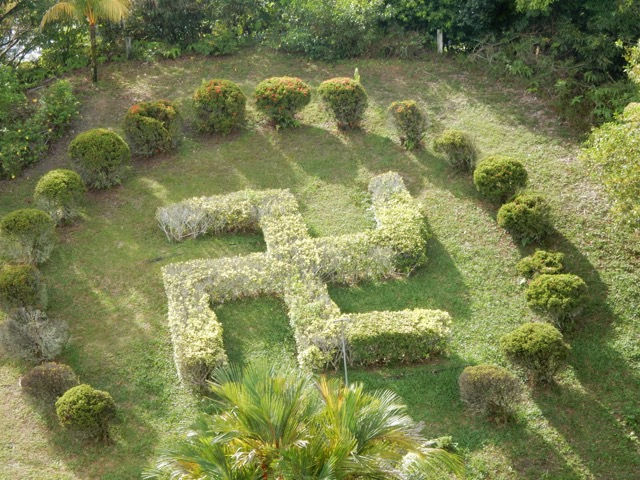
Gilded swastikas are visible everywhere. Remember that in the Buddhist religion, the swastika is the symbol of good fortune, not the horrific symbol it became remembered for as a result of the Holocaust.
Our next up was Sandakan Memorial Park, the site of a POW camp during World War II.

This particular park included a scale model of the camp as well as a number of interpretive stations and memorials for honoring the prisoners. It recognized a tragic death march of Australian soldiers, supervised by the Japanese during World War II. 2000 soldiers began the march and only six survived.

They were brutally murdered, starved to death, beheaded, and crucified. It was a sobering experience.
Some remnants of the actual equipment from 1943 remained on site.


As we walked through the memorial, our guide explained to me that this part of Borneo was only made part of Malaysia after the war. Before that, Brunei controlled all of Borneo, whereas now it only has 4%.
Our next stop was Buli SimSim, a traditional water village built on stilts over the bay.


We took a walk down some of the wooden “sidewalks” to see what life was like inside this village.
Of course, the first thing one would necessarily notice was the filth and trash that was knee-deep in the water.

Plastic bags were everywhere, again underscoring the reason they should be outlawed throughout the world. Garbage is collected once a month.

There were literally hundreds of these homes attached by these narrow wooden docks.

At one point, a woman was kind enough to invite us into her home. Moreover, she allowed us to take photographs. We were all amazed by the beautifully polished oak floors.
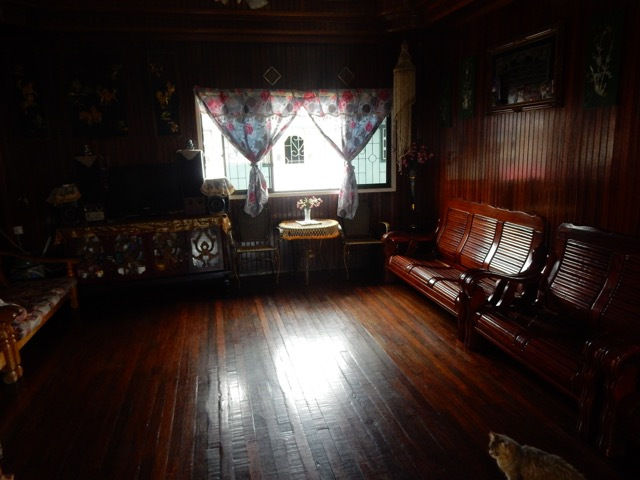
The exquisite furniture was also unexpected.

Overall, this home was quite spacious and larger than most American homes.

(But this family did harbor half a dozen or so cats, which forced me to leave rather abruptly for fear of an allergic reaction.)
Some families had fairly extensive gardens growing on their decks.

Our guide explained to us that working for the government provided many benefits to local people.Once they were government employees, they had access to bank loans, cars, and homes.
On the bus, we asked him about the use of drugs in Malaysia. He told us the punishments are quite harsh. If someone is caught with 200 g of marijuana, that person is put to death. If the person is caught with one marijuana cigarette, the sentence would probably be two years in prison.
Back in town, our next stop was at the Central Market.
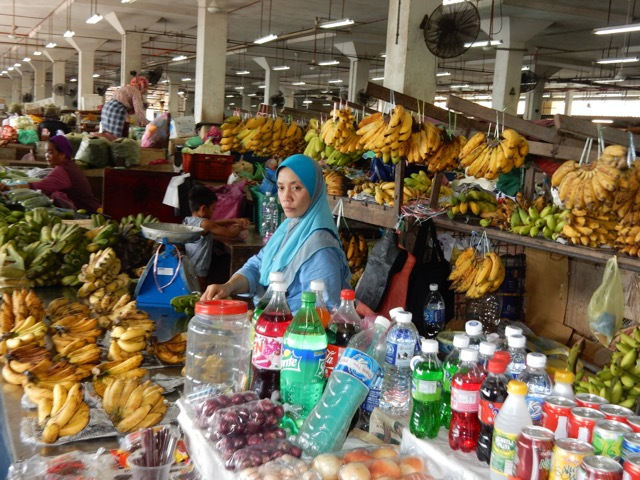
Souvenir shops and fresh fruit, vegetables, poultry, and dried fish filled the ground floor, while upstairs bustling food stalls offered an aromatic array of Malaysian curries.


Fish was abundant.


So were clams.

And bananas.

Finally, we drove to the hills above town to the former home of American author Agnes Keith and her husband. Although I have never heard of her, and I was an English major, she is famous for her novel, Land Below the Wind, which apparently won the Atlantic Monthly nonfiction award presented in 1939.
Mrs. Keith and her husband were prisoners of the Japanese internment camp from 1941 to 1945, and pictures throughout the home told that story. Unfortunately, we were not permitted to take photographs. But suffice it to to say this home was quite spacious and well-maintained.
Next door, we enjoyed a cup of tea at the English teahouse. This had been the former residence of the British Counsel General.

We were served scones and some yellow mushy stuff with a curry sauce. It was actually so good I had a second helping.
I had to go back into town because I needed a pair of hiking shoes.

Both pairs I maintained on the ship seem to have gone missing. We took the shuttle bus to town and when we first walked into the mall, we stopped at an information desk. I asked a lady where I could buy men’s shoes and she responded by asking me: “Do you want real shoes or imitations?” Ah yes, we’re in the land of counterfeits, that’s for sure. I couldn’t find a pair of decent hiking shoes, but after encountering used clothing and other unsuitable options I bought a pair of shoes that purport to be Nikes; although at $19 a pair, that of course cannot be the case.

Once I got back to the ship I was a bit knackered so I took a nap and read for a while before enjoying a typical World feast in East.


Comments